



Looking to refresh your old fences or install new ones? We’re the team you need! Reach out to us today!
Around 55% of households in the United States have a garden. Your fence is not just a frame to decorate your well-tended garden, it can be so much more. A fence adds a sense of privacy and boosts security and safety. Austin’s growing population and dense neighborhoods mean closer proximity to neighbors. The type of fence you choose can help create a more secluded space for you and your family. Let’s have a look at the best fence for Austin climate and residential areas.
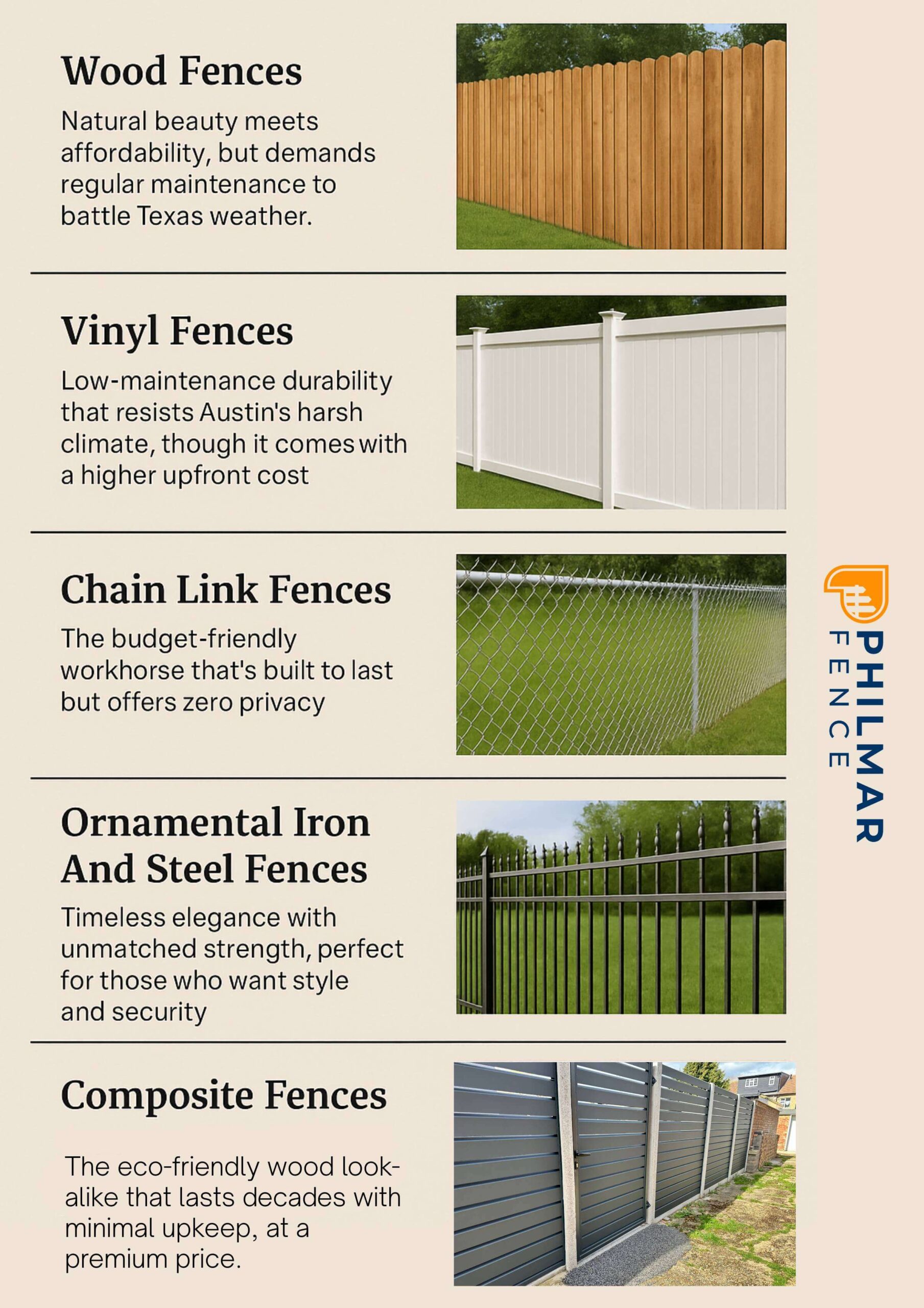
In Austin, choosing the best fence means you have to consider different materials and sizes, each having its own pros and cons. Let’s discuss the 5 most common fences along with their advantages and disadvantages.
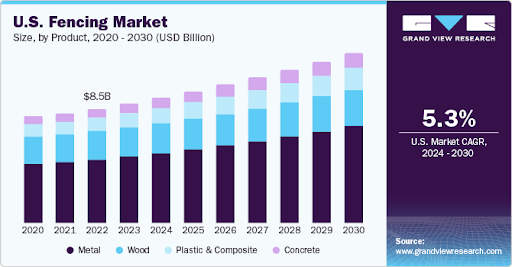
Wood fencing has the second-largest revenue share in the US of approximately 21.83%. Wood is a popular choice for Austin, Texas residential fences due to its versatility, natural beauty, and ability to reduce noise and provide privacy.
There are many different types of wood fences, including:
Pros | Cons |
Natural appearance to complement your home, and can be painted to match your home’s exterior | Requires regular maintenance, including sealing and staining to protect against water damage, rot, and insects |
Offers decent privacy depending on the spacing between the pickets and the style | Splits in the harsh weather of Texas are susceptible to warping |
Cost-effective option | Has a shorter lifespan as compared to other materials |
Environmentally friendly if the wood is sourced sustainably | Wood treatment chemicals may leach into the soil |
Vinyl fences are made from polyvinyl chloride (PVC), which is a synthetic polymer, along with some UV inhibitors and impact modifiers. It was first introduced in the 1980s as a low-cost, durable horse fencing. They are also used in many Austin households due to their low maintenance and durability as compared to traditional wood fences. Vinyl fences are the best fence for the Austin climate due to their capability to resist warping and cracking. There are many different styles of vinyl fences available, including:
Pros | Cons |
Low maintenance and durable, as it can withstand Austin’s harsh weather, moisture, and pests | It can be expensive compared to wood |
Offers a decent amount of privacy | Does not allow proper airflow, usually, making the fence susceptible to damage in strong storms or winds |
Does not need to be painted or stained | Entire panels will have to be replaced if repairs are required |
Chain Link fence has been around since 1844 in the UK and was introduced in the mid-1890s in the US. They are durable, secure, and low maintenance as they are made from galvanized iron. These types of fences are perfect if your home is located in a place where the winds are strong and the weather is harsh. Unlike vinyl fences, chain link fences are cost-effective. There are different types of coatings on chain link fences to keep them safe from rust and corrosion, such as:
Pros | Cons |
Cost-effective and customizable | Does not offer any privacy |
Durable and low maintenance | Prone to pitting and rusting over time |
Good to contain pets and children | Not aesthetically pleasing, and can look utilitarian |
Ornamental iron and steel fences are made from wrought iron (iron with low carbon content), steel, or aluminum. They accounted for around 40% of the global market share in 2022. As the name suggests, they are used mostly due to aesthetic appeal with added strength. Unlike galvanized iron fences, ornamental iron fences provide timeless elegance. Not just that, it is a popular choice to combat the intense Texas sun and occasional storms. It is resistant to rot, rust, and pests such as termites — a feature not available for wood fences.
Pros | Cons |
Reliable, durable, and lasts longer | More expensive than chain link or wood |
Secure and strong | May need rust prevention |
Recyclable | Energy-intensive production process |
In the US residential market, many homeowners choose composite fencing, representing up to 76% of the total plastic and composite fencing demand in 2022. Composite fences are typically made from 95% recycled materials, which makes them an environmentally friendly choice. They are designed to withstand strong Texas sun and occasional storms while maintaining the aesthetic appeal.
Pros | Cons |
Looks like wood and requires lower maintenance | Generally, more expensive than wood and vinyl fences |
Resistant to weathering, rot, and pests | Not fully recyclable |
Longer lifespan (can last up to 25 to 30 years) | Composite materials expand and contract with the change in temperature |
Before you select a fence, you should consider the following facts to ensure you get the best fence for your house:
When choosing a fence company in Austin, you have to ensure it suggests materials for your security fence verified by the local open-range laws and HOA regulations.
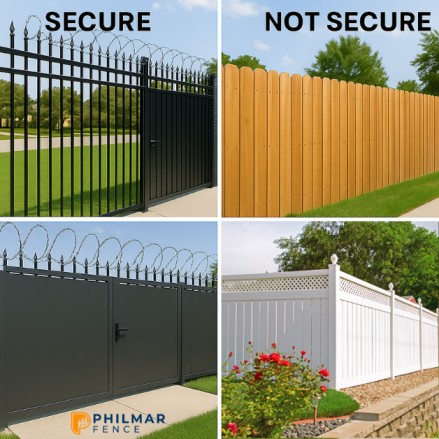
The best type of fence for home security is a tall, solid metal or composite fence with minimal gaps, anti-climb features, and a lockable gate. Wrought iron, steel, or composite fencing at least 6 feet high deters intruders by creating a visible, durable barrier. Unlike wooden fences, metal or composite materials resist cutting, scaling, and decay.
Fences with spear-topped pickets or flat panels with smooth finishes reduce grip points, while integrated gate locks and surveillance enhance deterrence. Visibility is also important—fences that allow a line of sight to the street prevent hiding spots and improve neighborhood vigilance.
Secure your property by choosing a tall, tamper-resistant fence with anti-climb features. Combine physical security with surveillance for maximum protection.
The best fence for Texas weather is a metal or composite fence that can withstand high heat, humidity, storms, and drought conditions. Texas weather includes intense sun, strong winds, and occasional hail, which can warp or rot wood and corrode low-grade materials.
Steel, aluminum, and wood-plastic composites offer long-term durability, low maintenance, and resistance to UV damage, pests, and moisture. Galvanized or powder-coated metals prevent rust, while composite materials resist fading and cracking. These fences handle rapid weather changes and require fewer repairs than untreated wood or vinyl.
Fence Type | Weather Resistance | Maintenance | Lifespan | Best Feature |
Galvanized Steel | Excellent (heat, wind, storms) | Low | 25+ years | Rust-proof, extremely durable |
Aluminum | Great (rust and warp resistant) | Very Low | 30+ years | Lightweight, won’t corrode |
Composite (Wood-Plastic) | Excellent (sun, rain, pests) | Low | 20–25 years | Fade-resistant, no rot or warp |
Cedar Wood (Treated) | Moderate (can handle dry climates) | Moderate | 15–20 years | Naturally insect-resistant |
Vinyl | Poor in heat (can warp or crack) | Low | 15–20 years | Low maintenance but heat-sensitive |
Choose a metal or composite fence to protect against extreme heat, strong winds, and moisture damage in Texas. These materials require less upkeep and last longer in harsh weather.
Choose the fence that adds security, style, and lasting value to your Austin home. Whether you need privacy, durability, or a neighbor-friendly solution, Philmar is a top-notch fence contractor that delivers expert craftsmanship and trusted service. Call Philmar today at (512) 910-0111 to schedule your free fencing consultation.
The best type of residential fencing is vinyl due to its low maintenance, durability, and clean appearance. Vinyl fences resist weathering, pests, and moisture better than wood. For privacy and longevity, vinyl outperforms wood and chain-link options in most residential settings.
A good neighbor fence in Texas is a shared wooden or vinyl fence where both sides look identical. It promotes fairness by not favoring one homeowner's view and typically aligns with HOA and local fencing regulations.
The highest fence allowed in Texas is 8 feet for residential properties, subject to local city codes. Front yard fences are typically limited to 4 feet. Always verify with the city or HOA for specific regulations.
Vinyl and wrought iron fences last the longest, with lifespans of 20 to over 50 years. Vinyl resists moisture and pests, while wrought iron withstands impact and weather when properly maintained. Wood fences typically last 10–15 years.