



Looking to refresh your old fences or install new ones? We’re the team you need! Reach out to us today!
Do you want to set a fence post on your Texas property? In that case, you should know the Fence post depth with concrete to avoid any fines.
The rule of thumb in Texas is to set fence posts so that one-third of the TOTAL post length is in the ground (which equals half of the above-ground fence height). You can use a fence post depth calculator for this. Generally, standard online guides suggest a 6-foot fence only needs 2 feet in concrete. But does that shallow depth hold up in Texas clay?
If you are still confused, a liberty hill fence company can guide you on this.
When planning post depth, use the one-third rule as a general starting point.
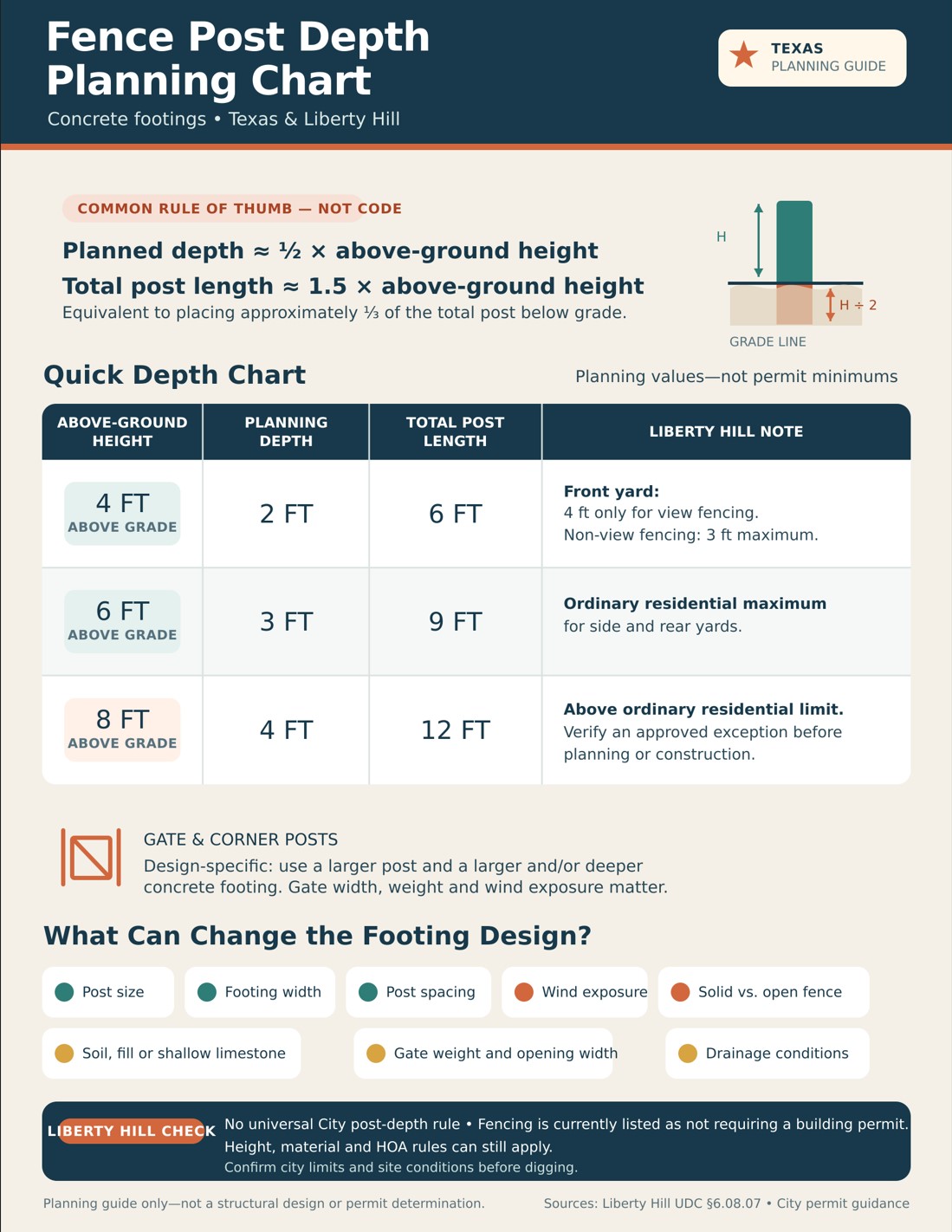
The ⅓ Rule: Set at least one-third of the TOTAL post length into the ground. A quick shortcut for this is making your post hole depth approximately half of your above-ground fence height.
The confusion around the ⅓ rule comes down to what you measure. Burying a post 2 feet deep for a 6-foot fence (using an 8-foot post) is only ⅓ of the fence height; a bare minimum that may fail in Texas depending on soil condition.
A conservative planning guideline is ⅓ of the TOTAL post length. Using this guideline gives you a 9-foot post buried 3 feet deep for a 6-foot fence, or a 12-foot post buried 4 feet deep for an 8-foot fence.
You can check this fence post depth chart to understand how it works.
Above-ground height | One-third-rule depth | Total post length | Liberty Hill note |
4 ft | 2 ft | 6 ft | Permitted in a front yard only when it qualifies as view fencing |
6 ft | 3 ft | 9 ft | Ordinary maximum for residential side and rear yards |
8 ft | 4 ft | 12 ft | Not allowed under ordinary residential height limits; verify an approved exception |
Gate/corner post | Design-specific | Design-specific | Use a larger post and larger/deeper footing |
Note: An 8-foot residential fence exceeds Liberty Hill’s ordinary six-foot side- and rear-yard height limit. Check local approval requirements before construction.
Actual footing requirements vary with the post size, footing diameter, post spacing, wind exposure, fence design and local soil or rock conditions. For custom fence heights:
The ratio is known as the good leverage resistance ratio. It works as an anchor against wind, sudden impacts, or generally potential pressure from the ground.
If you opt for lesser ratios like ¼, you may not get enough anchor mass. Burying more than 1/3 of the post (such as 1/2) provides extra strength against high winds, but it is rarely necessary for standard privacy fences and adds significant labor and concrete costs.
There is no single statewide building code that dictates the fence post depth for all private properties. Local ordinances, adopted codes, engineered designs, and private deed or HOA restrictions may apply. Many jurisdictions do not prescribe one universal post depth.
Do not assume that 24 inches is a Texas-wide minimum, particularly for an 8-foot fence. For instance, within Liberty Hill city limits, fencing is currently listed as not requiring a building permit. However, height, location, materials, easements, floodplain requirements, and HOA restrictions may still apply. Confirm whether the property is actually within Liberty Hill city limits before relying on municipal rules.
Liberty Hill officially lists fencing as not requiring a building permit, while its ordinance still controls fence height and materials. Liberty Hill permit information
Here are some fence post materials commonly used in Texas.
For a 6-ft fence, the recommended depth of posts is 2 feet. Metal fence posts are quite popular in Texas. That’s because they can easily resist high winds. Plus, they are set inside full concrete footings with a concrete cap sloped outward at the top, which makes them quite functional.
The recommended post depth follows the same ⅓ rule. Wood posts such as commonly used cedar fences are a bit tricky to handle. The best liberty hill fence company ensures to never pour the concrete under the post bottom. The right way is to set the wood directly on a gravel base to drain out the trapped water. The concrete poured around the sides prevents rot at the bottom.
Since vinyl has high wind resistance and flex issues, posts made from this material usually require deeper footings. Some experts use internal stiffeners made of aluminium so the posts can easily withstand the severe thunderstorms in Texas. In that case, the post depth may be equal to 2 to 2.5ft for a 6-ft long fence.
Most of Texas sits on expansive clay soil. It is considered one of the most challenging soil types for fence installation. That’s because the soil expands when it is wet. It then shrinks when it gets dry and retains water for long periods.
This expansion puts lots of pressure on fence posts.
What does that mean? The pressure makes fence posts gradually lean or shift. Fence gates become misaligned after some time. Besides, the panels detach or warp, and the overall lifespan of the fence is reduced.
That’s why the depth of the posts is important. In addition, the installation technique also makes a lot of difference.
Here are some methods or tips that may help your posts stand solid for long.
As a safety measure, make sure that before digging any post holes, you always call Texas 811. The team will mark underground public utility lines for free.
Setting up your fence posts is more than just about the depth. You can set the posts if the fence is under 4 feet, the soil is quite stable, and there are no drainage issues around.
However, you may need the help of a professional if the fence is 6 feet or longer. Plus, if the soil shifts or cracks easily and you require long-term durability, it is best to get a reputable fence company on board.
Professionals make sure to evaluate the soil conditions before installing the posts at the correct depth. They also ensure proper drainage and use better materials so that the posts last for a long time.
Do you want your fence posts to withstand the wind and harsh weather conditions of Texas? If yes, you should get our professional fence experts on board. From choosing the correct depth of your fence posts to selecting the right materials, we make sure to manage this job within your deadline. We are well aware that fence installation is less about carpentry and more about understanding soil behavior, and that’s what makes us different from the rest. Call now and book an appointment!
An 8-foot post leaves only 21 inches underground. Longer posts allowing roughly three feet of embedment are more conservative, but 10-foot posts are not universally required and do not guarantee hurricane resistance.
Not automatically. Caliche strength varies, so the footing may require deeper drilling or a different design based on the actual soil and wind load; 24 inches is not a universal Texas requirement.
Being below the frost line does not ensure adequate wind resistance. For a solid six-foot fence, 24–36 inches is a more conservative planning range, depending on soil, post spacing, footing size, and exposure.
Sometimes. Sound posts may be reset in properly sized footings, while rotten, broken, bent, or undersized posts should be replaced.
Texas has no single post-depth requirement that makes a 20-inch installation automatically illegal. Builders must follow applicable local rules and project specifications, and a failed fence should be evaluated against its design, contract, and site conditions.