



Looking to refresh your old fences or install new ones? We’re the team you need! Reach out to us today!
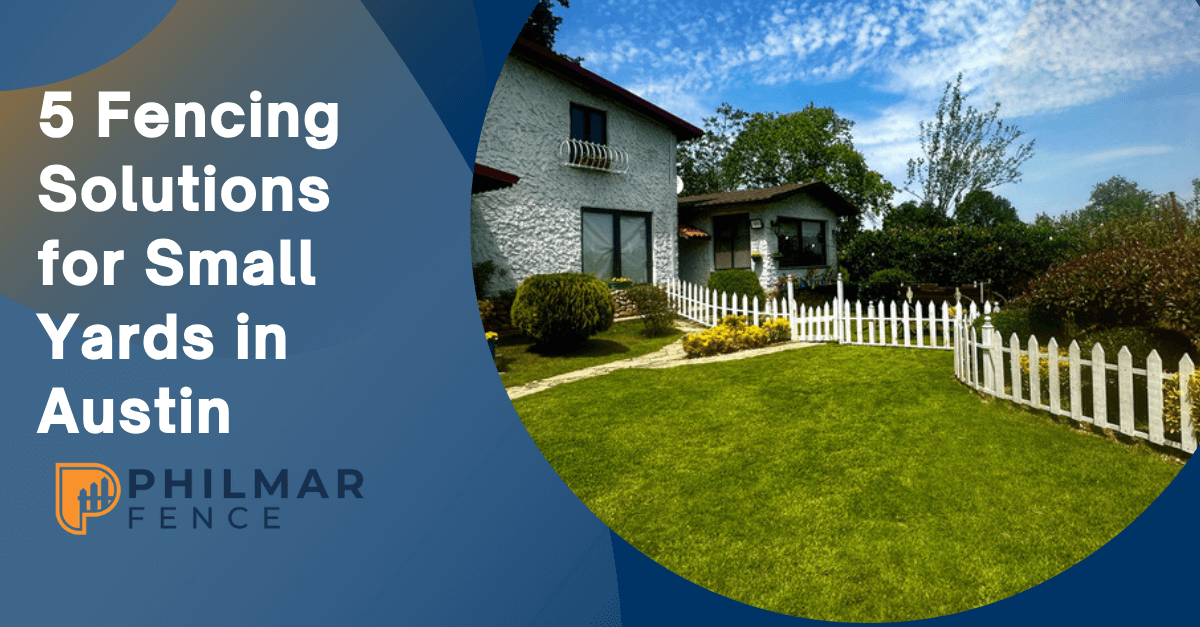
Small yards in Austin are slowly becoming the standard. That's because Austin has a relentless sun with an unforgiving soil. People prefer small yards to overcome these challenges.
But when choosing a fencing solution, you have to find a balance of aesthetics, local regulations, and material durability.
Imagine a compact outdoor space looking more like a cramped corridor than an expansive oasis. That's what a wrong fence solution can do.
Here are five fences for small yards in Austin that may be perfect for your home.
This fence solution is great for people looking to introduce modern aesthetics in their yards. The style makes your narrow yard look wide and beautiful.
A horizontal slat fence is primarily aesthetic and privacy-focused. It creates a sleek and high-end look.
This helps complement Austin’s architectural style and is common in newer urban projects.
These fences are usually made of Western Red Cedar or composite materials. The materials help create boards running parallel to the ground. Homeowners in Austin prefer this contemporary and architectural feel.
Airflow is non-negotiable in Central Texas. It gets extremely humid (67% is the average humidity) and hot in Austin. Many homeowners prefer leaving small gaps between the horizontal slats to increase breathability.
This prevents the yard from trapping heat during July afternoons. Plus, it helps the breeze to circulate through your outdoor living space.
The iron or aluminium fence is also in the list of popular Austin Texas residential fences. This fence solution is mostly preferred to keep your house and yard secure. But it also adds some aesthetics to the entire space.
The best thing about such fences is that they feature slim vertical pickets. This offers a sophisticated and timeless look. It also works as a sturdy barrier.
Most modern houses use powder-coated aluminum fences. Aluminum doesn't rust. This is a major plus point. Austin’s long humid stretches and heavy spring rains can ruin any other material used.
Another great thing about this solution is that an iron fence provides a "transparent" boundary.
Many people in Austin love the “outdoor living” concept. Such fences help keep pets and children safe, meeting the security purpose.
An aluminum privacy fence costs $75 to $130 per linear foot installed. These fences are costlier than wood or vinyl fences. But they are durable and have a lifespan of 30 to 50 years.
If you are looking for a solution that provides semi-privacy, the Shadowbox fence may be one of the best fences for small yards in Austin.
This fence looks identical on both sides. This means neither you nor your neighbor has to look at the ugly side.
The fence has a very practical design. It alternates the pickets on the front and back of the fence rails.
What does that do? It creates an overlapping pattern that looks solid from a distance. However, when viewed from an angle, it reveals gaps.
This makes the fence visually interesting. Plus, when the light and shadow play through the slats, they add depth to a small space.
Additionally, when it comes to durability, this fence doesn't disappoint. It can stand firmly against the storms or spring wind gusts that can be very strong at times. The fence doesn't lean or snap.
Shadowbox fencing costs around $2,700 to $8,500 depending on the fence's length, material, and height. So, make sure that you have the budget available to facilitate this expenditure.
Most Austin Texas residential fences are designed to maximize nature.
This fence solution utilizes a thin structural frame. The homeowners often prefer a simple wire mesh or a light wooden trellis to support climbing plants. Trellis fencing provides some privacy as well.
At $3 to $7 per linear foot, this is a low-cost fence option for small yards.
If you want to go for this fence solution, you can use a cattle panel or a cedar lattice. These are popular industrial looks. Once that's ready, you can plant native Texas climbers like Crossvine or Star Jasmine around it.
In Austin, concrete and wood houses soak up heat. In that case, a living fence works as a natural evaporative cooler.
What's more, it offers a habitat for local pollinators. This is what Austin's gardening community lives for.
What do you use your small yard for?
It is common to utilize this space for multiple functions, such as a trash bin area, a dog walk zone, and more.
So, what would be a perfect fence for multiple purposes? A hybrid fence uses different materials for varying sections to maximize utility.
For instance, it is common to see a 6-foot cedar privacy section for the sitting area and a lower 3-foot iron section for the front yard.
Austin homes also have wood fences with sections made of iron bars. These bars help to let the light pass.
With a hybrid fence made with a mix of metal and wood , you can prioritize privacy for the patio while maintaining an open feel for the rest of the property.
The right fence type can elevate the look of your small yard. Plus, it can provide you with the required privacy.
Confused about which fence solution to pick? Get in touch with our team at Philmar to help you decide and build the perfect boundary for your small yard. We have experience building beautiful and practical fences in Austin. Contact us now at (512) 910-0111 and book a meeting!
In Austin, you can typically build a residential fence up to 8 feet tall without a permit, provided it is not located in a floodplain or along a city right-of-way.
Horizontal slats are ideal for narrow spaces as they visually elongate the yard to make it appear wider, while vertical slats draw the eye upward to create an illusion of height.
Western Red Cedar is highly recommended for its natural resistance to rot and insects, though light-colored vinyl or composite are better for those seeking a "zero-maintenance" solution that reflects UV rays.
Yes, multi-functional designs like "living walls" with integrated planters or built-in bench seating allow you to maximize every square inch of a compact Austin lot.
To avoid a "boxed-in" feeling, homeowners often choose semi-private styles like shadowbox or lattice-top fences, which provide seclusion while allowing light and airflow to pass through.